Alone in the Room, Never Alone in the Song: The Secret Behind Adi Ulmansky's Creative Process
Alone in the Room, Never Alone in the Song: The Secret Behind Adi Ulmansky's Creative Process
There's a particular kind of magic that happens when a song feels like it was written specifically for you — like the artist somehow climbed inside your exact headspace and put words to something you'd been carrying around for months without a name. That's the Adi Ulmansky effect. And the wild part? She usually writes completely alone.
The paradox at the center of her work is one of the most interesting things about her as an artist. The more solitary the process, the more communal the result. The quieter the room, the louder the recognition her listeners feel. It's not a coincidence. It's craft.
The Room Where It Happens (And It's Probably Very Quiet)
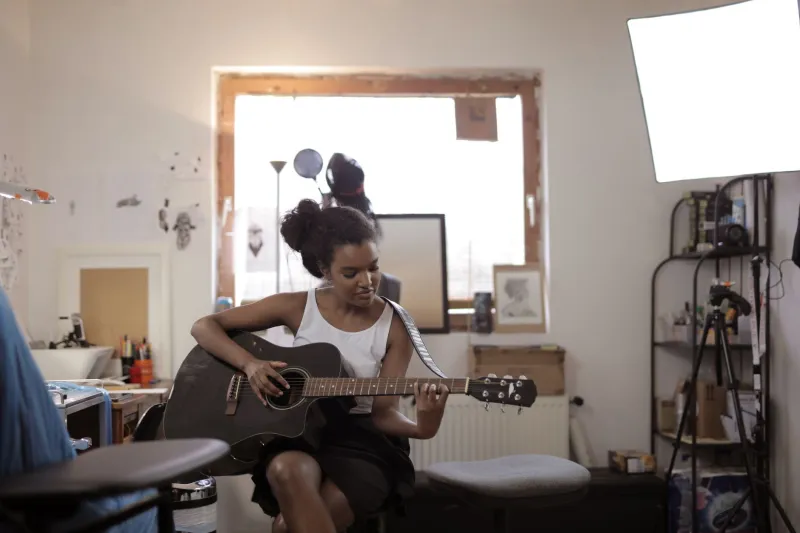
Adi has talked openly about the conditions under which her best work tends to emerge. It's not a buzzing studio full of collaborators throwing ideas at a whiteboard. It's closer to the opposite — late hours, minimal distraction, a kind of deliberate stillness that most people actively avoid.
There's something almost countercultural about that in 2024, when the music industry increasingly runs on co-writing sessions, algorithmic trend-chasing, and the constant pressure to stay plugged in. Adi leans the other way. She treats solitude not as a limitation but as a resource — a creative condition that allows her to hear things she'd otherwise miss.
For American listeners raised on the mythology of the lone artist — think Carole King at the piano, Elliott Smith in a corner, Phoebe Bridgers in the dark — this resonates on a deep level. There's a long tradition in American music of valuing the work that comes out of a single person sitting with their own thoughts long enough to find something true. Adi slots right into that lineage, even as she brings her own distinctly Tel Aviv-inflected perspective to it.
Silence as an Instrument
One of the most underrated elements of Adi's songwriting is what she leaves out. The space in her arrangements isn't accidental — it's architectural. She uses silence the way a good filmmaker uses negative space: to draw your attention exactly where she wants it, and to let meaning accumulate in the gaps.
This is a skill that's genuinely hard to teach. Most producers and writers, especially early in their careers, tend to fill every available sonic moment. More is more. Adi operates from a different instinct. She seems to understand that restraint creates intimacy, and intimacy is the whole ballgame when you're trying to make someone feel less alone at midnight.
That conversational quality fans describe when they encounter her music for the first time — the sense that she's talking to you, not at you — comes directly from this. When the arrangement breathes, you breathe with it. When she pauses before a lyric, you lean in. The silence is doing work.
Writing From the Inside Out
Adi's lyrics tend to start from a specific emotional truth rather than a narrative concept. She's not typically building a story from the outside in, constructing characters and plot points. She's excavating something internal and then finding the language that fits it — which is a harder, messier, more vulnerable process, and it shows in the work in the best possible way.
This is also why her songs age so well. Music that starts from genuine feeling tends to stay true across different contexts and life stages. You might hear an Adi Ulmansky track at 22 going through your first real heartbreak, and then again at 34 navigating something completely different, and somehow it still fits. The specificity of her emotional starting point creates a kind of universality that more generalized songwriting can't replicate.
For American audiences especially — who've grown up in a culture that simultaneously celebrates emotional openness and makes it weirdly hard to actually practice — this kind of unguarded honesty in music hits differently. It gives people permission. It says: you're allowed to feel this, and it makes sense, and you're not the only one.
The Ritual of Getting There
Every songwriter who works in isolation develops rituals — the specific conditions, habits, or sequences that reliably open the door to the good stuff. Adi's process, from what she's shared, involves a kind of patient waiting. Not passive waiting, but active: tuning out the noise, sitting with whatever's present emotionally, and trusting that the material will surface if she creates the right conditions for it.
There's a meditative quality to this that feels increasingly rare in an attention economy built around constant stimulation. She's essentially doing the opposite of doomscrolling. She's going inward on purpose, staying there long enough for something real to emerge, and then translating that into sound.
For listeners, the result of this process is music that rewards the same kind of attention it was made with. Adi's songs are not background noise. They're foreground experiences. They ask something of you — your full presence, your willingness to actually feel something — and they give back accordingly.
Why Lonely Music Brings People Together
There's a reason certain artists become the unofficial soundtrack to other people's solitude. It's not despite the loneliness baked into their process — it's because of it. When someone writes from a genuinely isolated place, the resulting work carries a frequency that other isolated people can tune into. It becomes a form of remote companionship.
Adi Ulmansky has built a fanbase in the US that operates this way. Her listeners find each other through her music — in comment sections, in shared playlists, in the slightly sheepish confession that yes, they too have cried to this song in their car at 11 PM on a Tuesday. The music creates community precisely because it was born from the absence of it.
That's the paradox she's resolved, almost without seeming to try. One person, alone in a room, following a thread of feeling until it becomes a song — and then that song finds its way to thousands of people who needed exactly that, at exactly the right moment.
If that's not connection, nothing is.
The Takeaway
Adi Ulmansky's process is a reminder that the most communal art often comes from the most private places. The solitude isn't a bug — it's the whole feature. It's what makes the music feel like a secret shared between her and whoever's listening, rather than a product aimed at a demographic.
In a music landscape that sometimes feels engineered within an inch of its life, that kind of authenticity is genuinely rare. And American listeners, whatever else you want to say about them, are very good at recognizing the real thing when they hear it.